Arriving at Faro Airport, even at 9am, the first thing that struck me was the heat. Coming from England, where we had needed to scrape the ice off the car before leaving, and arriving in Faro where it was t-shirt weather. The mild climate, made birding very enjoyable, not to mention that it provided the perfect environment for a fantastic array of wintering birds. The most obvious of which were visible on our drive to Aljezur, where we were staying.
Cattle Egrets Bubulcus ibis littered the sides of the road and most fields, along with
Iberian Magpies Cyanopica cyanus exploding from most bushes, sometimes in sizeable flocks of over 50 birds. Unfortunately, the day was taken up primarily with trivial tasks and it wasn't until the evening that I could actually walk the land around the house. The evening sun illuminated the shrubbery and a few birds were still flycatching in its golden glow. On my ten minute walk before the sun completely disappeared I was able to pick up on two sylvias,
Sardinian Warbler Sylvia Melanocephala and
Dartford Warbler Sylvia undata a nice duo to observe on your back door step.
Sardinian Warbler Sylvia Melanocephala
The 8th dawned, and once again it was a clear day, with the sun beating down as always. No time was wasted, and I set about exploring the area more thoroughly. Both
Dartford and
Sardinian Warbler were still chattering in the undergrowth, occasionally visible through the thick cover. Birds still seemed quite active many calling as part of the dawn chorus. Included in the mix were
Common Chiffchaff Phylloscopus Collybita, Great Spotted Woodpecker Dendrocopos major, Serin Serinus serinus and of course both sylvia warblers.
Great Spotted Woodpecker Dendrocopos major
On the wires a group of three
Woodlarks Lullula arborea were singing accomponied by some
Spotless Starlings Sturnus unicolor. A flight of
Crag Martins Ptyonoprogne rupestris circled overhead, occasionally being lunged at by a hungry
Kestrel Falco tinnunculus. Moving on to a more overgrown area, I was instantly greeted by a
Zitting Cisticola Cisticola juncidis which flushed from the dense undergrowth and a small group of four
Cirl Buntings Emberiza cirlus trilled nearby.
Cirl Bunting Emberiza cirlus
Zitting Cisticola Cisticola juncidis
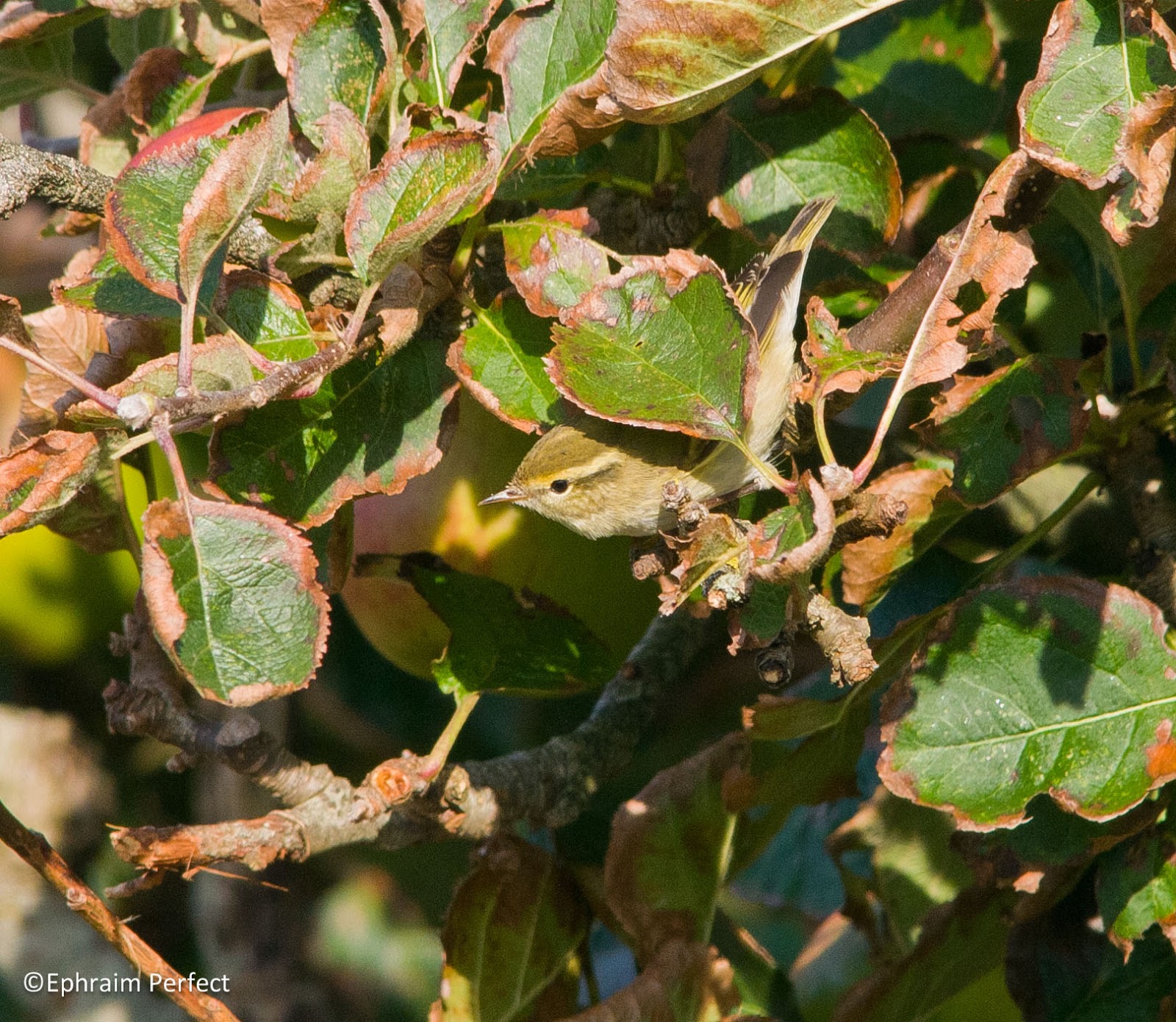
Finally, I approached the stream running along the bottom of the valley, where I had heard a faint call reminiscent of Yellow-browed Warbler the evening before. Once again I picked up the distinctive "tsew-wit" call of a
Yellow-browed Warbler Phylloscopus inornatus, and this time there was no doubt in my mind. The bird did eventually show itself, its citrus supercilium s out from behind the leaves. Incredibly, there were a mere 20 records of this elegant species from 1985-2010, with irruption years since then producing dozens more. It is still a description species in Portugal, but whether this is because of a lack of coverage or that this is still a scarce sibe is unknown. However, I would favour the former, due to reports of a wintering population in Iberia.
Yellow-browed Warbler (record shot) Phylloscopus inornatus
Back to work on he 9th again, sorting out various problems with the house, a brief walk around the area produced very little new, but the same birds were still on show. An errand trip saw me and my father head out to Portimão in the afternoon. I saw this as an opportunity, to visit a nature reserve en route. I was dropped off at 15:30 with an hour an a half to run round Ria de Alvor before the sun would set. A magnificent pair of
Black-winged Kites Elanus caeruleus hunted not to far from the road, but a tight time schedule didn't leave me much time to admire them.
Black-winged Kite Elanus caeruleus
Once at the reserve, there was a half an hour walk to the actual salt marsh. However, this was far from uneventful, more
Zitting Cisticola Cisticola juncidis easily reaching double figures called from around the paths, triple figures of
White Stork Ciconia ciconia were also visible, accompanied by the usual Portuguese specialities including
Iberian Magpie Cyanopica cyanus,
Cattle Egret Bubulcus ibis,
Common Waxbill Estrilda astrild,
Hoopoe Upupa epops and
Sardinian Warbler Sylvia Melanocephala.
Stonechat Saxicola rubicola
White Stork Ciconia ciconia
The salt marsh itself borders onto the sea (or rather Ocean) creating a wide variety of habitats. On the beach, groups of waders were feeding on the invertebrates, mostly birds we are familiar with in Britain,
Grey Plover Pluvialis squatarola,
Ringed Plover Chaadrius hiaticula,
Kentish Plover Charadrius alexandrinus,
Knot Calidris canutus,
Redshank Tinga erythropus,
Greenshank Tringa stagnatilis,
Sanderling Calidris alba and
Dunlin Calidis alpina.
Dunlin Calidris alpina
Separated by a bank of mud, the lagoons held a completely different selection of birds,
Spoonbills Platalea leucorodia sifted through the water next to resting
Black-winged Stilts Himantopus himantopus among other waders like
Common Sandpiper Actitis hypoleucos,
Golden Plover Pluvialis apricaria and most notably
Greater Flamingo Phoenicopterus roseus! On the passerine front the highlight was my first ever
Bluethroat Luscinia svecica, a full male seen for a total of 3 seconds.
Greater Flamingo Phoenicopterus roseus
The 10th saw very little change in terms of diversity, another stroll around the area produced no new species, instead I was adamant on photographing a
Sardinian Warbler Sylvia Melanocephala, since they had evaded my camera thus far.
Sardinian Warbler Sylvia melanocephala
The 11th was our last day in Portugal, I spent as much time checking the local area as possible which turned up a fly over
Rock Bunting Emberiza cia and a pair of
Nuthatch Sitta europaea (not quite on the same level). Before boarding the plane at Faro back to London Gatwick, we stopped at Ria Formosa, one of Portugal's most famous wildlife reserves.
Ria Formosa with roosting Little Egret
It was just before 4pm when we arrived, which left little time to explore, but I did my best. The reserve once again held a magnitude of wildlife, over a hundred waders could be seen feeding on a single lagoon, mostly made up of
Redshank Tringa totanus,
Greenshank Tringa nebularia,
Sanderling Calidris alba and other common wintering waders. The first birds I saw on exiting the car were two
Booted Eagles Aquila pennata, a pale morph and a juv. thermaling up among a group of
White Storks Ciconia ciconia. On the reserve, you were surrounded by the calls of various warblers,
Sardinian,
Willow and even
Zitting Cisticola. A
Black-winged Kite Elanus caeruleus hovered above one of the lagoons, occasionally diving into the grass, flocks of
Black-tailed Godwits Limosa limosa flew over, relocating to another lagoon,
Little Egrets Egretta garzetta fed in the shallows and huge numbers of
Coots Fulica atra and Gulls
Larus were to be seen.
Black-tailed Godwit Limosa limosa
Black-winged Kite Elanus Caeruleus
Further on, another lagoon held an astounding amount of avifauna. There were flocks of
White Stork Ciconia ciconia,
Flamingo Phoenicopterus roseus,
Spoonbill Platalea leucorodia,
Grey Heron Ardea cinerea,
Shoveler Anas clypeata,
Wigeon Anas penelope,
Teal Anas crecca,
Great Crested Grebe Podiceps cristatus and
Black-winged Stilt Himantopus himantopus!
Flock of Wigeon Anas penelope
Spoonbill Platalea leucorodia
The lagoon was a veritable mecca for wintering birds. As the sun began to set, I had to make my way back, but not without one last scan, which revealed a
Caspian Tern Hydroprogne caspia and
Sandwich Tern Sterna sandvicensis feeding and diving into the lagoons.
Caspian Tern Hydroprogne caspia
Sandwich Tern Sterna sandvicensis
It was a huge shame that I only had an hour to enjoy it, I worry about the countless birds I must have missed.