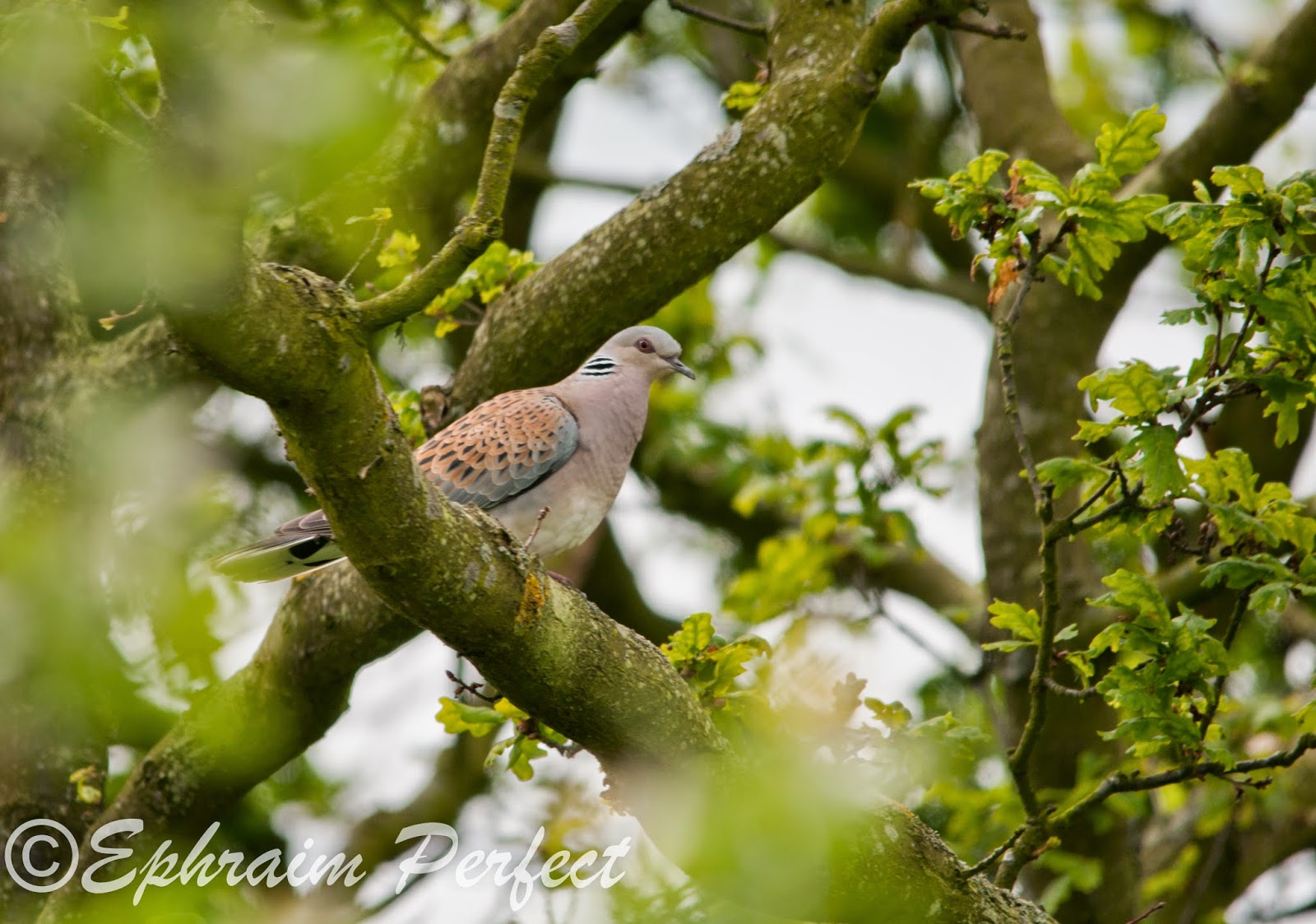
Once I had seen the Glossy Ibis I heard a commotion from the surrounding trees of the reserve and three Cuckoos flew out chasing each other, they put on a great display before going back into the trees. This happened a number of times before I moved on to get better views of the Turtle Doves. Since I had seen the three key species I had hoped to see I spent the next few hours watching the Turtle Doves. The seemed obliging at first and showed nicely, however they never showed properly without any distractions in front of them which proved a problem for photography. But persistence paid off after a while and I managed to rattle off a few decent pictures of one perched on a branch. Because of its "elusive" nature I mainly focused on filming it rather than photographing it.
Saturday, 31 May 2014
Otmoor RSPB with Turtle Dove
I managed to drag myself into half term after having finished only just over half of my exams. It was a relief, but I had to go straight back into revising, so I was left with my spirits completely shattered and I was bored out of my wits. But then I managed to make a deal with my mum and she took me to Otmoor RSPB. A large expanse of amazing habitat for hundreds of different species of birds, butterflies and more. We arrived on the reserve and we instantly picked up the soft purr of a Turtle Dove. It didn't take long before I had seen my first one in an odd place, the marsh, where I was initially looking for the long staying Glossy Ibis. Shortly after I managed to locate the Glossy Ibis as well, it was hidden very well behind long distracting tufts of grass. It proved very elusive over the few hours I was there and only came out for a minute or so before being pushed back into the undergrowth by a Little Egret.
Once I had seen the Glossy Ibis I heard a commotion from the surrounding trees of the reserve and three Cuckoos flew out chasing each other, they put on a great display before going back into the trees. This happened a number of times before I moved on to get better views of the Turtle Doves. Since I had seen the three key species I had hoped to see I spent the next few hours watching the Turtle Doves. The seemed obliging at first and showed nicely, however they never showed properly without any distractions in front of them which proved a problem for photography. But persistence paid off after a while and I managed to rattle off a few decent pictures of one perched on a branch. Because of its "elusive" nature I mainly focused on filming it rather than photographing it.
Monday, 5 May 2014
A day out of the ordinary
As I have mentioned in many of my blog post I have my GCSE's coming up. Infact they are starting this week. However, today had a strange turn of events. I had planned to do more revision, but when a sighting of a possible Lesser Yellowlegs at College Lake was reported I almost fell of my chair. This is an absolute MEGA inland. My pessimistic side got the better of me and decided it would probably turn out to be nothing more than a Redshank or something of that sort. Later that day a full report was released and there was no more possible or probable about it. This was great news so I rounded my mum and dad up and "asked" them to give me a lift to Tring. In the car I could hardly contain myself and I was bouncing around longing to get to College Lake. We eventually made it there and I sprinted out the car onto the reserve. I lifted up my binoculars and there it was, a little distant, but easily visible from the reserve entrance. I followed the bird around a little trying to anticipate its moves, where it might go, occasionally getting it right. A group of birders and I managed to find the birds favorite feeding point and we managed to get some absolutely cracking views.
Lesser Yellowlegs (as you had probably guessed)
Even though it was harassed by a Lapwing each time it came to the point, it was determined to feed from that particular area of marshland. Along the way I managed to pick up and spot a few other goodies, which included: Little Ringed Plover, Redshank, Turnstone, Swift, Sand Martin and a fly over Hobby which made a few passes.
Thursday, 10 April 2014
White Wagtails and more on the patch!
Well those that regularly read my blog will probably know that my patch is not the greatest place for birds, but over the last few days it has been working wonders. On me and my brothers first visit together we picked up 42 Golden Plover which had been flushed by a Buzzard flying over head.
This was a patch first so obviously I was very exited, as was my brother. We then headed down to the canal where my brother had found a Cetti's Warbler a few days before. We managed to connect with it within about 15 minutes when a huge explosion of sound came from one of the bushes. We saw glimpses of it, but no more. All in all a great day on patch! The next day after a rain fall we tried our luck in the fields behind the RSSKL and with a bit of scanning my brother managed to find a male Wheatear amongst numerous Meadow Pipits! The next day my brother headed off to Bricket Woods and I decided to do a little patch work on my own. I quickly picked up 2 Lapwing in the fields and a Wheatear.
I moved a little along to get better views and I then quickly found a second female Wheatear! I anticipated that there may be a White Wagtail on this field which had already produced 2 Wheatear and I scoured the entire field for them, but there was no sign of any. I texted my brother with my finds and he made a stop off at the field on his way home. Now here's the annoying part. He found himself one of the Wheatears and a White Wagtail. Because of this I walked to the field today again and managed to locate the White Wagtails.
Golden Plover
This was a patch first so obviously I was very exited, as was my brother. We then headed down to the canal where my brother had found a Cetti's Warbler a few days before. We managed to connect with it within about 15 minutes when a huge explosion of sound came from one of the bushes. We saw glimpses of it, but no more. All in all a great day on patch! The next day after a rain fall we tried our luck in the fields behind the RSSKL and with a bit of scanning my brother managed to find a male Wheatear amongst numerous Meadow Pipits! The next day my brother headed off to Bricket Woods and I decided to do a little patch work on my own. I quickly picked up 2 Lapwing in the fields and a Wheatear.
Lapwing
Male Wheatear
I moved a little along to get better views and I then quickly found a second female Wheatear! I anticipated that there may be a White Wagtail on this field which had already produced 2 Wheatear and I scoured the entire field for them, but there was no sign of any. I texted my brother with my finds and he made a stop off at the field on his way home. Now here's the annoying part. He found himself one of the Wheatears and a White Wagtail. Because of this I walked to the field today again and managed to locate the White Wagtails.
White Wagtail
Monday, 7 April 2014
Catching up!
Right then, once again I haven't written a blog post in a month. I keep telling myself I'll write more often, but here we are. To be truthful I haven't really had much of a reason to write a blog post apart from a trip to Portland.
Portland
Paul, Chris and I left at some ungodly hour in the morning to take a small trip to Portland. After a smooth trip we arrived at Ferry Bridge where we saw some Red-breasted Merganser and then it was straight off the the harbour. There we saw yet more Red-breasted Merganser and a lone Black Guillemot which was soon to malt into its summer plumage. We were soon on the bill and scanning any sea birds which dared tempt fate by fly on the harsh and stormy sea. We picked up a few Guillemots, Fulmars and varies types of common Gulls, but nothing which was of much interest so I moved on and found myself my first thriving yet battered male Wheatear. Chris and Paul were to late to see it, but we eventually found ourselves a female BLACK REDSTART to raise the spirits and quickly after an extra 2 Wheatear, a couple, both male and female. With this success we headed for the cliffs. Ravens flew lazily and easily over the cliffs giving us brilliant views and a Peregrine maneuvered speedily around the cliffs. Portland was as one would expect apart from any migrants. Once we reached the car again we agreed the long staying Iceland Gull would be or best bet. I didn't have much hope for it, but after a few minutes of scanning Paul found it. We went to have a closer look, but it flew in a different direction so we followed it again. By the end we had covered the whole beach just following the bird. Eventually the bird gave a few fly by passes and we were content.
We then did a quick stop at the Harbour and Ferry Bridge before heading off home.
Other than my trip to Portland I haven't done much birding wise.
Thanks for reading.
Portland
Paul, Chris and I left at some ungodly hour in the morning to take a small trip to Portland. After a smooth trip we arrived at Ferry Bridge where we saw some Red-breasted Merganser and then it was straight off the the harbour. There we saw yet more Red-breasted Merganser and a lone Black Guillemot which was soon to malt into its summer plumage. We were soon on the bill and scanning any sea birds which dared tempt fate by fly on the harsh and stormy sea. We picked up a few Guillemots, Fulmars and varies types of common Gulls, but nothing which was of much interest so I moved on and found myself my first thriving yet battered male Wheatear. Chris and Paul were to late to see it, but we eventually found ourselves a female BLACK REDSTART to raise the spirits and quickly after an extra 2 Wheatear, a couple, both male and female. With this success we headed for the cliffs. Ravens flew lazily and easily over the cliffs giving us brilliant views and a Peregrine maneuvered speedily around the cliffs. Portland was as one would expect apart from any migrants. Once we reached the car again we agreed the long staying Iceland Gull would be or best bet. I didn't have much hope for it, but after a few minutes of scanning Paul found it. We went to have a closer look, but it flew in a different direction so we followed it again. By the end we had covered the whole beach just following the bird. Eventually the bird gave a few fly by passes and we were content.
Iceland Gull
We then did a quick stop at the Harbour and Ferry Bridge before heading off home.
Other than my trip to Portland I haven't done much birding wise.
Thanks for reading.
Monday, 3 March 2014
Wow it's been a while
Well I didn't get round to writing a post in February so here's one for March. As you probably can tell from my more recent post I am getting closer to my GCSE's and my life is being taken over by them. Photography is what's taking away my weekends, unfortunately or fortunately this is what's stopping most of my twitching and birding and replacing it with taking pictures of mallards. Not the most interesting of subjects.
As I hope you can see my project is on movement. I began the project with these Mallards in St Albans, the movement is conveyed quite simply through a long shutter speed and throwing seed in for the ducks. After developing a technique such as this I went on to develop it using the same technique, but changing the subject or idea. I did both and moved on to two fighting Moorhen.
Once again in this picture I wanted to emphasis the chaos and action. Perhaps freezing the shot slightly more would have achieved a better result. Well then now that I had finished this section of the project it was time to move onto another sub-theme still keeping the idea of movement. What better to do than WATER. This is when timing was crucial, luckily I was heading down to Cornwall were there is plenty of water at the moment and proved a perfect opportunity to photograph the idealistic streams which run through Cornwall's countryside.
Well that's about where I'm up to now in the project, which has taken me a surprisingly long 4-6 weeks. But now back to the birding, on the way down to Cornwall and on the way back I took some stops. Firstly for the Red-flanked Bluetail which unfortunately me and 5 others dipped and secondly to the long staying Lesser Scaup in Bodmin Moor.
Lesser Scaup (furthest to the left)
Well then we are reaching the end of my post, I hope you enjoyed reading it if you did and I would like to leave you with some of my entries to the Veolia Wildlife Photographer of the Year Competition.
And that's about it.
Subscribe to:
Posts (Atom)